Sunday, February 3, 2019

Multimedia Project Research

Module 2 Idea


For module 2 I plan to create a better version of my game from the first semester, I will keep the same style and idea but I am going to do a much better job. 

There are a few reason I have decided that this is what I want to do, the first reason being I really wasn't happy with how my original game turned out as I really didn't put enough time into it. Overall I enjoyed making the game creating the landscape, characters and such was fun. I am hoping that because we don't have to deal with Group project that I will have a lot more time to really create something I am happy with this semester. 

Another major factor which has made me decide that I want to work on my game is that this year there has been a lot of group work and so I feel like I'd rather just work by myself. 

The final reason I'd like to work on my game is after seeing other peoples game it has gave me a better idea on what is achievable and what I could implement into my game.  

(This is a picture of Scooby-Doo Night of 100 frights which I would like to replicate, This image is from Wikipedia)


Thursday, November 29, 2018

Unity Free Tutorials

Unity Free Tutorials Week 9

This week I have choose to follow on from last weeks how to design a character for unity to how to animate a character for unity. These are what I plan to use for my NPC's. I found the tutorial on youtube and this is the link. 

This is a small video I recorded from in Unity to show a basic animation I applied to my character.


The second tutorial I have worked on is creating a mini map for my game, I also found this on Youtube and it is a video from Jimmy Vegas here is the link.

This is a screen shot form Unity

The tutorials were both easy to follow, I struggled a little to make get my map to become a circle but I figured out i just missed a small step in making it become a mask. I think both of these tutorials will be really useful in my game as they are big parts of the idea of my game.
 

Tuesday, November 27, 2018

Game Stories

Week 9 Reading

The first reading is about how stories need a hero and it talks about how myths and old stories have been breed into humans as the people who could convince tribes that the preservation of the tribe was more important than the individuals life is more important than their own would have had the best chance of survival and so these are the genes that would have lasted the longest and we more than likely possess. It talks about how stories give us purpose and without them life would seem pointless. 

The second reading talks about how games are not films and films are not plays. He breaks down how films had to adapt after they started as they were thought to be like plays which we know films obviously aren't, it then talks about how games are different to films but they still need story. It suggests that games without stories attract small crowd and don't really keep an audience which I don't think is really true as games such as Fifa and Call of Duty maintain a huge fan base each yea despite no major story or it not being the main aspect of the game. Also another really good example of this not applying is Fortnite despite it not being everyone's cup of tea you can't deny that it is extremely popular and successful. 

(This is an image of Fortnite taken from Flickr)

Thursday, November 22, 2018

Week 8 Progress

Week 8 Progress

1. Looking back

I am not really happy with my progress so as I really hoped that I would get a week ahead of where we are supposed to be so that I could be a little bit more relaxed and organised but unfortunately due to all the week from each of the modules I haven't been able to do that and have feel behind. I was going well until 2 weeks ago when I couldn't get my final GDD done and I had every intention to finish it the next day but some how I still haven't got around to it and I also didn't get to start my prototype last week as my group and I are a good bit behind in Group Project so really focusing on that. The assignments I like the most are definitely the tutorials as they are fun while also being educational. On the progress chart I feel I am doing okay I had 169 at the end of week 7 so this is basically in line to be a B so I plan to stay on top of everything and do a few extra credit tasks to get a B for the semester. 

2. Looking Forward

I really want to catch up with the project work for the second half of the semester as that is the whole point of the module and I'd be really disappointed if I didn't catch up. I plan to work on my game a lot more once I get the presentation out of the way for group project. I'd also like to stick to the timetable I set myself at the start of the year more closely just so I am making sure I being as efficient as I can be. 

( This is a picture I got from pxhere to represent busyness)

Wednesday, November 21, 2018

Week 8 Comments and Feedback

Week 8 Comments and Feedback


1. Feedback in

I think the comments I am getting in are useful and make me take a second look at everything I do as usually when you complete some work or an assignment you forget about it and don't look back at it, but when you get a comment it makes you look back at your work constantly and when you look back over it you sometimes you think differently about it, for example at the time you could be thinking it's great and there's nothing else you could explore but then someone will comment on it and mention something you didn't even consider and now you have a completely different area to look into and explore. 

2. Feedback out

I'd like to think that the comments I am leaving on others blog are helpful for them. When I do my commenting I always try to look at their project or their writing with an open mind and give my opinion on how I think they can improve their idea. I use the technique we learned early on in the module, TAG, this is Tell them something you like, Ask them something you may find unclear or something they could talk more about and Give an opinion or idea regarding their game.

3. Blog Comments

Yeah I think you do get to know people more from reading there blogs especially from their introductions, People have some really good introductions where they talk about cool things they've done, things they want to do, their favourite books and films and their goals when they finish college, which gives you a really good understanding of who they are as a person before you even talk to them which is really cool. Overall I am happy with how my blog portrays me in a sense as it has a lot of aspects that I like so this represents my taste and style, for instance I really like using the cursive font as I just think it looks really well and I like for things to be neat and uniform and for the most part I feel my blog reflects that, but, I am not happy with my introduction. When we had to do it and it showed all the things we should talk about I misread it and took it that we should talk about one of them so as a result my introduction is all about my sporting career as a kid. I think if I had an easier to comment on introduction I may have got more comments on my blog as a whole because my introduction is very hard to comment on and even I wouldn't want to comment on it.

4. looking Forward

Going forward I will try to be a bit more focused on the individual persons project idea and give them my input on their idea rather than just my ideas made to reflect their theme. Hopefully this will benefit both me and the person I am giving the feedback to as they will get feedback better related to their project and I will be able to expand my thinking and get inspiration from more places.


Tuesday, November 20, 2018

Week 8 Reading and Writting

Reading and Writing 

This week we are reviewing our readings and writing from the last 7 weeks and talking about what we have learned and what we want to learn.

My thoughts on the readings
I feel like a lot of the readings have been interesting but I don't think they were heaped full of useful information. All of the readings were about vastly different things, some being about board games and some being about players dynamics, but most of them felt that they weren't that transferable to our own stuff. With stuff like Web Development you learn how to do the basics first and then you start looking at reasons why you should do things and why it works. I feel like Multimedia could do a similar thing like in the first semester our readings could be more based on what we literally need to know to make a game maybe it was expected we would go and search for this stuff ourselves. I think readings about how and why coding works, how to create textures and designs in Photoshop that you can use in Unity would have been more useful and practical for our first semester of Multimedia so that we can actually have some good information behind us that we know is needed because although we are college student and we should be able to look up our own research a lot of the time it is very overbearing and daunting especially with the workload from all the modules. 

My thought on what we learned
The readings thought me that you have to think a lot about every aspect of your game from colours and icons to make sure thing is accessible for everyone. For instance a person who is slightly colour blind might have a hard time differentiating between red and orange so you need to make vastly different things stand out from each other using say red and blue but someone who is completely colour blind will not even be able to tell the difference of these so you should also have an icon so that players don't need to see the colour to be able to differentiate objects. Another one of our readings talked about how players van be broke into 4 main categories, Achievers, Diggers, Socalisers and Killers. The article talks about how in a game a player will mainly be one of 4 play styles, they might dabble in the other ones but it is usually just to progress there original play style. I liked this reading most as i felt like it was most useful to understand as I think it is easier to make a fun game for people if you know what people like so by understanding what people like you can try facilitate as many people as possible. We also had a really useful reading in one of the earlier weeks about MDA, this is Mechanics, Dynamics and Aesthetics these are the three main tings you should consider when designing a game, Mechanics are what you can and can't do i.e jump but you can't double jump, Dynamics are how the mechanics work and cooperate and Aesthetics is the feeling it evokes in people.

What I'd Like to Learn
I'd like to learn more about the coding and animation part of game design as I feel this is the real bread and butter of making a game, your game will be very boring if there is no code put into it and without animation any NPC's you have may as well just be an inanimate object. 

 ( This is probably my favourite image I have used as I feel like Super Mario is definitely one of the more recognisable games and it has a lot you can learn from. This image is Devant Art)

Thursday, November 15, 2018

Unity Free Tutorials

Unity Free Tutorials

First Tutorial

For my first tutorial I looked up how to make a character in Unity so I could make some NPCs for my game. I looked this up on Google and it brought me to Youtube where I found an easy to follow to tutorial. 

This is a link to it: 
https://www.youtube.com/watch?v=BN0okzfjSp8 

I found it really easy to create my character as you are given sample body types and them you can do it how ever you like by using sliders to adjust so many different things to do with it such as it's height, arm length, weight, facial expressions and you can also put a load of different clothes on it. 

( This is a screenshot of my character in Unity)

Second Tutorial

The second tutorial I looked at was how to create an animation with the camera, I found this animation on the unity website, In theory it was easy but I found it a bit difficult to get the camera to go where I wanted it to. 

This is a link to the tutorial:
https://unity3d.com/learn/tutorials/topics/animation/animation-view?playlist=17099

( This is a screen recording of the animation I created with the Camera in Unity)


Tuesday, November 13, 2018

Game Fun

Reading Week 7

The first article is Natural Funativity.
This article is all about how it is in our genes to play games. The author talks about how tens of thousands of years ago people would play games to improve their survival skills and in a way that is what we still do to this day. He used the example of a hunter coming home after a successful hunt he has three options go back out to try get more food even though its dangerous, just rest until he starts to run out of food but risk being a bit rusty when he goes out hunting again or in the safety of camp he can practise his survival skills by throwing a rock at a balancing piece of wood. The author talks about to this day we are still affected by what our ancestors done.

The second article is Players who suit MUD's (MMO's).
This article talks about the 4 different reasons people enjoyed a popular MMO years ago and how it can be seen to categorise all gamers effectively. The four different types are Achievers, Explorers, Socialisers and Killers. It talks about how many players will be a bit of all but they mainly are one and do the others to progress there main play style or just based off there mood that day. The article states games can easily die if there is too much or similarly too little of a type as it will hinder other peoples fun. 

(This is a picture of the GTA Online logo as I feel like this is a good representation of the second article, Image taken from WikiMedia)

Tuesday, November 6, 2018

Game Decisions

Reading Week 6

This week for our reading we read an article about cosy games. The article talks about how to make a cosy game, why people enjoy them and some common misconceptions about what makes a game cosy.

To make a cosy game you need to make it so there are no high priority tasks such as eating to survive or having shelter. This makes a player done something, once this happens a game is no longer. A cosy game has no risks or danger in it, instead of trying to survive you instead try to master a skill, connect with people or just simply explore. 

People enjoy cosy games as they are completely different than most games you'll play where there are set tasks and you are usually at some sort of risk.

Many people think to have a cosy game you just need to make it cute or to have a feeling of safety but this isn't true there are many needs for a cosy game to make it successful. One example of a common misconception people have about cosy games the article talks about is that the whole game needs to be cosy and safe but this isn't true, they make the example that if you have a little cosy reading nook with a window and cold rain is hitting the window because you are safe and the rain is outside the cosy space it actually enhances the feeling of cosiness.

Another article I looked at was Cosy Games Make Winter More Bearable, This article talks about how various aspects of cosy games can make or break them such as the minimalism of it or the use of notifications.

A second article I found interesting was I Love Astroneer For Its Optimism, this article explains how this survival game is actually cosy despite literally suffocating to death at times.

The final article I found interesting was Animal Crossing Helps Me Cope On A Day Like This, this article is wrote by someone who had a hard upbringing as they felt like an outsider in this article they talk about how animal crossing helped them both as a kid and also as an adult to appreciate life and everything around them.
(This is an image from Flickr of Animal Crossing)
 

Sunday, October 28, 2018

Game Design Document

Game Design Document 

I think it was a lot easier to create the Game Design Document this week as t really focuses you on each section and helps you stay more on track. There was a lot of sections that I didn't really know what to write about. I liked Dundoc and feel it will be easy to update as we go on and get more info about our project.

This is the link to my Dundoc.   

Spyro is a game I feel relates to my idea.
This image is taken from WikiMedia


Thursday, October 25, 2018

Unity Tutorial 05

Unity Tutorial 5

This week in unity we done a good bit. I think that it was really interesting as we used Animation for the first time which we will obviously need a lot for our games and using it was actually easier than I thought it would be, for more advanced animation it will obviously be harder to make them run smoothly ect. but as a starting point it was fairly easy.

I liked creating the text and extra cursor for when you hover over the gem as I think this will give us a lot of originality, one example of how we could use this is creating different cursors for different weapons, this will create different feel for different weapons and it will also just look cooler.

The text will be really useful as well as this will be the main way to communicate with different people and objects. So far we have a good bit of information to use for our game I feel like if I sat down for a good while and messed around with it I could create a few different interact able objects.(probably just different gems as of now) 

One thing which I don't know what I am doing wrong is everything I press play and go into the game the noise that happens when you collect the gem plays even though I have it set so none of the sound options play on awake.

Overall I am enjoying Unity and find it fun to mess around with.


(This is a screenshot from in my Unity World to show the Axe, Gem and Action Text.) 

Wednesday, October 24, 2018

Game GDD

Reading Week 5

One article I read was Only a Game Roger Caillois Patterns of Play. In this article the author talks about how Roger Caillois broke games and he said there are 4 patterns of play. Competitive, Chance, Simulation or Vertigo, I think this is an interesting concept and cool to think about different games and see where they fit in.

A second article I read was called Conversation, this article talks about how you should go about having conversations with NPCs. I liked this as it got me thinking what kind of conversations I'd like to have in my game, I think as it is an adventure game I will like for the NPCs to give out helpful information so it will be heavily scripted.

The final article I read was The In-Game economics of Ultima Online, I liked the article, it breaks down the basic concept of the game but one bit that made me think was,

 Game designers are therefore frequently confronted with the following dilemma:
  1. All elements of the game need to be fun.
  2. Much of the real world is not fun.
  3. Elements which are unrealistic are often counterintuitive.
  4. Counterintuitive rules are difficult to learn and not fun, at least at first
This is good to keep in mind when designing my own game.

For the main reading I think there was a lot of useful information on good design consideration, but I feel like there is also a good amount of information that isn't really transferable from board game to computer game such as include spare parts. Nevertheless I actually think having to root around a lot of information helps you retain the good information more. I will definitely be looking back on this when designing my game as there are a lot of useful tips such as using different colours and shapes to help people who are colour blind differentiate between things easier. 

Image taken from Pixabay, showing some board game pieces

Sunday, October 21, 2018

Game Vision Statement

Game Vision Statement

Game Genre

The genre will be Adventure. It will be an open world (not too big as I want it to be designed good enough that taking on too much could be stupid) that you explore looking for treasure map pieces in order to find hidden treasure. 

Game play

I want the traversal to be fun as I feel like adventure games that can do this while having a good story always turn out to be great e.g Spiderman, GTA, Red Dead Redemption and Skyrim. Like most of these games the travelling wont just be travelling as there will be enemies to fight and cool areas to explore.

Resources Required

The main resource which will be required is time as the project is just for college and wont be commercial. I'll need a lot of time to complete my project as I'll have to look up a lot of things to make the game I want.

Link to Resource

This is a link to an article I read which talks about pressure plates and how when you walk on it you can have various things to happen such as playing sounds, opening doors and a few more things this will definitely be useful for game development

(This is an image i found on WikiMedia and I really like how this looks both the on screen HUD and the look of it this would make for a really good map in my opinion and will definitely keep it in mind during my game development, This is from the game Armello which was developed by League of Geeks and made with Unity)
.

Thursday, October 18, 2018

Unity Tutorial 3

Unity Tutorial 3

In this weeks tutorial we learned how to make a functioning clock. We used game objects to make it which I think is really useful as we will be able to use stuff like this in our game.

Joining objects together will help us make a lot of objects in our games from houses, bridges and structures. I think a good tutorial would be how to make textures as this could really give us a lot of individuality in how we design certain aspects.

I struggled at first rotating the hour marks as I thought I was supposed to make all the hour marks inside the face but once I realised what I was supposed to do I thought the rest was fairly easy. 

I was working on this lab in college and was 3/4s of the way through it but I couldn't really progress too much when I got home as for some reason it wouldn't let me do the coding and I couldn't download Visual Studio.

So far I am really enjoying playing with Unity and think this module will be really fun.

(This is the screen shot I took from Unity of my clock)


Tuesday, October 16, 2018

Games MDA

Week 4 Readings

This week our reading was a lot more in depth than before I felt,The first article basically explained MDA (Mechanics, Dynamics and Aesthetics). Learning about this stuff although slightly confusing is going to be very useful for making our game,Mechanics of a game are kind of like the rules and affects your dynamics, which is how the game plays and aesthetics are the feelings you want the player to experience while playing your game.

The author gave us some examples of aesthetics which I think will be useful to really categorize our game ideas. Some of them include Fantasy, Discovery, Challenge and Narrative. Knowing how to describe the games in development terms will be useful to look up information on developing them.

The second article was all about intentional playing from players and the mechanics you set up in your game can lead to low or high intentional game play. The author says how he thinks making the player have high intentional playing styles is the best way forward for the gaming industry, he shows us how we can do this and how some games have implemented it both good and poorly. The article it's self was kind of confusing at times but I feel like the overall point was to convey the power that giving players multiply ways of doing things can lead to more enjoyable and long lasting content.

Additional Readings

A look at negative game behavior 

This article talks about the hindrance that is games semi-forcing micro transactions to progress.

The Paper chase saving money via paper prototyping

This article talks about ways to save money prototyping your games. (aimed at real developers I think)

Modelling Conversation Flow: NPCs repeating information

This article talks about ways to deal with NPCs getting asked the same question repeatedly.

 
(An image of Dark Souls Board Game as one article talked about board games influencing video games, image taken from flickr)

Monday, October 15, 2018

Feedback Strategies

Feed Back Strategies 


I liked these articles as they thought me how praise isn't always a good thing which never occurred to me before.

In Five Reasons to Stop saying Good Job it talks about the various reasons why saying good job to young children hinders their development more so than helping them, It suggests it applies to people of all ages but mainly young kids. One of the reasons which I thought was really interesting was that by saying good job to a child for some of the work they've done they then attach that to the feeling of the praise and it becomes less about the actually task and more about the praise, which I thought was really peculiar. I liked the last section of this article a lot as it focused on what you should say rather than why it is bad and I thought this was helpful as it seems like it is focused for everyone's feedback rather than just kids.

In The difference between praise and feedback it talks about two experts in the matters opinion on feedback and one explains how she thinks that the generic good job and stuff is bad and says how she thinks you should say stuff like "You can tell you put a lot of effort in" and general observations rather than judgement. Whereas the second person says that this is just passing judgement on effort and that you should rather ask the kid how they feel about it like how did you find that or which was the hardest part of it.

Overall i feel like the first one was more useful for now the second one might come in handy when I have a kid but how praise affects kids is mainly what I took from the second article whereas I felt like I took some useful information on giving feedback from the first one.

                  (Image of a star taken from WikiMedia
            as this is what I think of when I think of Feedback)

Friday, October 12, 2018

Game Idea Research

                          Game Idea 

I have decided I would like to look more into an open world game where you progress by finding objectives. I have decided to look more into this sort of game as I really enjoy playing these games myself, so I feel like this would help me identify what I like and therefore help me create an enjoyable game.

First Game Mechanic
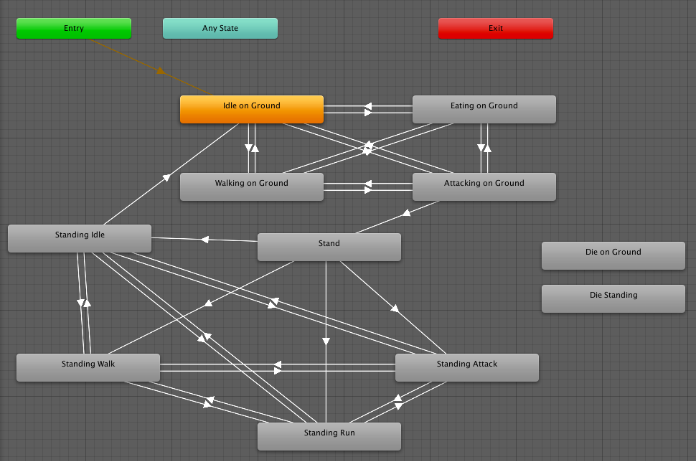
The first game mechanic I looked into was about NPCs, It was called How to Create Non Playable Characters (NPCs) in Unity 2018 I found a useful article about how to set up the animations and transitions for these. In the article they just downloaded the characters and the animations so I didn't learn much about that aspect but I learned about how to set the default state for them and how to join up the animations to progress between them.


(This is an image taken from the article I read and shows how you could set up your transitions)

Second Game Mechanic
The second mechanic I looked into was all about the Interaction System from a Unity tutorial. I think this article will be useful in the future as it talks all about how you can get different objects to interact with each other and the various ways you can do this. One method I found which I feel will be very useful for my main game idea is the inventory checks you can perform, this will be really useful as it means instead of the character completing the level as soon as they get the object they will also bring it back to the objective meaning more game play.

                             (screenshot taken from the article showing the inventory checks)

Third Game Mechanic
The third game mechanic I found which I think will definitely come in handy for developing my game was found in Jimmy Vegas How to make a game for free video number 6. This is how to make objects interact able, in the video he creates an extra UI to show instructions on how to pick up a gem but I would imagine that by using the same method you will be able to create similar instructions for talking to NPC's and such which will be a vital part of my game.

Overall I feel like I have a few basic building tools already to help me design a game that I would find interesting.  

Thursday, October 11, 2018

Unity Tutorial 02

Unity Tutorial 2

I really enjoyed the second Unity tutorial as I feel you can really see how the customization is coming in to it. I also feel like the videos are great as you get a whole load of information really quickly and if you need to look back you can always re-watch the video whenever you need. I actually really enjoy the tutorial videos as I find them really interesting and just think it is so cool that we can literally make a game and with the help of the tutorials we can do it bit by bit.

There is also a lot of useful things in these videos to help with my game idea such as making objects being able to be picked up and such which is the key part of one of my ideas. I also think that the standard asset file is really useful as when I was messing around with unity at home I didn't have this for some reason and then when I went into college and was playing with it I seen just how much stuff there is in it, So there should definitely be a few bits and bobs in there to help with our games.

I think this is a good way to learn as because we have a few deadlines a week it feels like we don't have as much work to do rather than other classes were we have our lecture and lab, they give us work due for the next week and so they give us a lot and it all piles up.

                              (Picture of a kid Binge watching TV from Wikicommons)

Monday, October 8, 2018

Game Elements

Week 3 Readings


This weeks readings was all about learning the vocab needed to communicate effectively as you are building a game. It mainly focused on how we can dissect games to discover how they make us like or dislike them, he showed this by explaining the FADTs of Mario. One example of this is how in Mario you have a certain amount of actions you can do and these actions always available because of this you always know what you can or can't do based on these moves, You can try and jump up to a platform and if you can't reach it you have to do something else. 

They also talk about how you can mix FADTs to achieve the kind of game you want. For example if you are making a free flowing sports game you can't create your own story, as the players actions are what really defines the story, i.e the player can't be winning a game 5-nil and then you make them take a peno which decides if they win or not as it doesn't make any sense. So therefore if you are making a free flowing sports game you won't rely on story to much but more so on stuff like Intention, i.e you want to win as much as possible and Consequence, i.e when you press a button you know what will happen.

I found the reading really interesting especially reading his analysis of super Mario. I liked how he broke Mario down and explained what made it likable and what not. Also reading his analysis of Mario and seeing how he broke it down seems like it will come in handy in future game development as I feel like I could look at games I really like and be able to deconstruct them and figure out why i like them and how to use that in games I make. 


(Image taken from Devaintart, Mario 64 Logo)


Sunday, October 7, 2018

Feedback thoughts

A lot of the time when I am getting feed back I expect the worst, I expect them to be really negative and to just highlight all the bad things in my work so I'm prepared for if this happens, but, the majority of the time this isn't the case. I found especially in college it is very rare that you'll be given feedback (by lecturers I don't think most of us students have had enough practice yet) which highlights your mistakes as it usually highlights why they are mistakes or highlights good work you've done and how by following the guides you followed to achieve them results you can improve on all your work.

I feel like in secondary school a lot of the time you didn't really get feedback, you got a percentage (if they converted it for you) and a generic comment like "good work" or "needs work". No matter what result you get none of these comments are helpful as they are really impersonal, like the teacher just wrote one or the other depending on what grade you got rather than how you're work actually was.

The two articles I read were Neil Gaiman's advice on  the creative life and Why it's so hard to hear negative feedback
I liked the second article I read "Why its hard to hear negative feedback" as I felt it gave some good tips on what to do when both getting and giving feedback.

Overall I think although it can be hard to hear sometimes feedback is a great tool for learning.

                                              (Image taken from Pixabay, classic sign for feedback)