Showing posts with label Week 3. Show all posts

Monday, October 15, 2018

Feedback Strategies

Feed Back Strategies 


I liked these articles as they thought me how praise isn't always a good thing which never occurred to me before.

In Five Reasons to Stop saying Good Job it talks about the various reasons why saying good job to young children hinders their development more so than helping them, It suggests it applies to people of all ages but mainly young kids. One of the reasons which I thought was really interesting was that by saying good job to a child for some of the work they've done they then attach that to the feeling of the praise and it becomes less about the actually task and more about the praise, which I thought was really peculiar. I liked the last section of this article a lot as it focused on what you should say rather than why it is bad and I thought this was helpful as it seems like it is focused for everyone's feedback rather than just kids.

In The difference between praise and feedback it talks about two experts in the matters opinion on feedback and one explains how she thinks that the generic good job and stuff is bad and says how she thinks you should say stuff like "You can tell you put a lot of effort in" and general observations rather than judgement. Whereas the second person says that this is just passing judgement on effort and that you should rather ask the kid how they feel about it like how did you find that or which was the hardest part of it.

Overall i feel like the first one was more useful for now the second one might come in handy when I have a kid but how praise affects kids is mainly what I took from the second article whereas I felt like I took some useful information on giving feedback from the first one.

                  (Image of a star taken from WikiMedia
            as this is what I think of when I think of Feedback)

Friday, October 12, 2018

Game Idea Research

                          Game Idea 

I have decided I would like to look more into an open world game where you progress by finding objectives. I have decided to look more into this sort of game as I really enjoy playing these games myself, so I feel like this would help me identify what I like and therefore help me create an enjoyable game.

First Game Mechanic
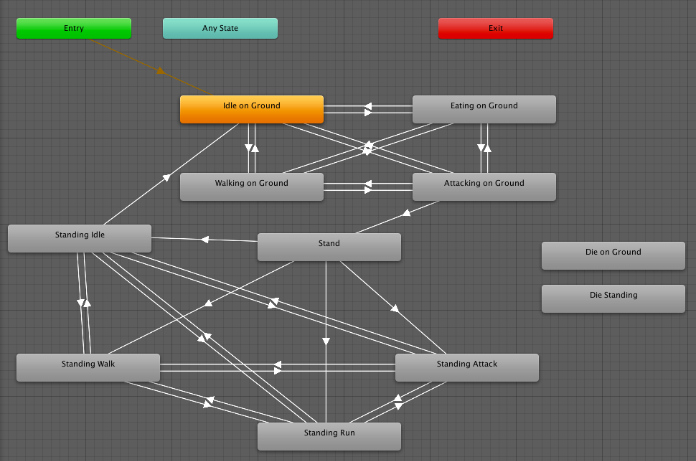
The first game mechanic I looked into was about NPCs, It was called How to Create Non Playable Characters (NPCs) in Unity 2018 I found a useful article about how to set up the animations and transitions for these. In the article they just downloaded the characters and the animations so I didn't learn much about that aspect but I learned about how to set the default state for them and how to join up the animations to progress between them.


(This is an image taken from the article I read and shows how you could set up your transitions)

Second Game Mechanic
The second mechanic I looked into was all about the Interaction System from a Unity tutorial. I think this article will be useful in the future as it talks all about how you can get different objects to interact with each other and the various ways you can do this. One method I found which I feel will be very useful for my main game idea is the inventory checks you can perform, this will be really useful as it means instead of the character completing the level as soon as they get the object they will also bring it back to the objective meaning more game play.

                             (screenshot taken from the article showing the inventory checks)

Third Game Mechanic
The third game mechanic I found which I think will definitely come in handy for developing my game was found in Jimmy Vegas How to make a game for free video number 6. This is how to make objects interact able, in the video he creates an extra UI to show instructions on how to pick up a gem but I would imagine that by using the same method you will be able to create similar instructions for talking to NPC's and such which will be a vital part of my game.

Overall I feel like I have a few basic building tools already to help me design a game that I would find interesting.  

Thursday, October 11, 2018

Unity Tutorial 02

Unity Tutorial 2

I really enjoyed the second Unity tutorial as I feel you can really see how the customization is coming in to it. I also feel like the videos are great as you get a whole load of information really quickly and if you need to look back you can always re-watch the video whenever you need. I actually really enjoy the tutorial videos as I find them really interesting and just think it is so cool that we can literally make a game and with the help of the tutorials we can do it bit by bit.

There is also a lot of useful things in these videos to help with my game idea such as making objects being able to be picked up and such which is the key part of one of my ideas. I also think that the standard asset file is really useful as when I was messing around with unity at home I didn't have this for some reason and then when I went into college and was playing with it I seen just how much stuff there is in it, So there should definitely be a few bits and bobs in there to help with our games.

I think this is a good way to learn as because we have a few deadlines a week it feels like we don't have as much work to do rather than other classes were we have our lecture and lab, they give us work due for the next week and so they give us a lot and it all piles up.

                              (Picture of a kid Binge watching TV from Wikicommons)

Monday, October 8, 2018

Game Elements

Week 3 Readings


This weeks readings was all about learning the vocab needed to communicate effectively as you are building a game. It mainly focused on how we can dissect games to discover how they make us like or dislike them, he showed this by explaining the FADTs of Mario. One example of this is how in Mario you have a certain amount of actions you can do and these actions always available because of this you always know what you can or can't do based on these moves, You can try and jump up to a platform and if you can't reach it you have to do something else. 

They also talk about how you can mix FADTs to achieve the kind of game you want. For example if you are making a free flowing sports game you can't create your own story, as the players actions are what really defines the story, i.e the player can't be winning a game 5-nil and then you make them take a peno which decides if they win or not as it doesn't make any sense. So therefore if you are making a free flowing sports game you won't rely on story to much but more so on stuff like Intention, i.e you want to win as much as possible and Consequence, i.e when you press a button you know what will happen.

I found the reading really interesting especially reading his analysis of super Mario. I liked how he broke Mario down and explained what made it likable and what not. Also reading his analysis of Mario and seeing how he broke it down seems like it will come in handy in future game development as I feel like I could look at games I really like and be able to deconstruct them and figure out why i like them and how to use that in games I make. 


(Image taken from Devaintart, Mario 64 Logo)